About
The web page for this composition is in progress. Please contact me at gerald@nullgeraldcohenmusic.com for more information about the piece.
Children’s Aid Society Chorus Commission Award 2007
Text
Poem by Walt Whitman

The web page for this composition is in progress. Please contact me at gerald@nullgeraldcohenmusic.com for more information about the piece.
Children’s Aid Society Chorus Commission Award 2007
Poem by Walt Whitman
The web page for this composition is in progress. Please contact me at gerald@nullgeraldcohenmusic.com for more information about the piece.
Commissioned by Congregation B’nai Israel, Sylvania, OH
The web page for this composition is in progress. Please contact me at gerald@nullgeraldcohenmusic.com for more information about the piece.
Commissioned by Baltimore Hebrew Congregation
About – Score – Arrangements – Listen/Watch – Text – Performances
Dodi li vaani lo (My beloved is mine, and I am his) was commissioned for Cantabile Chamber Chorale by Mitzi Lasky and Seth and Carolyn Rudnick, in memory of their parents, Dr. Stanford and Lucille Batter Rudnick, and by Cantabile. This piece was also written in celebration of Cantabile’s 20th anniversary as a chorus, all under the direction of Rebecca Scott, and it was the 3rd piece that I have written for Cantabile–it has been so significant for me to be an active part of their musical lives! The premiere of the piece took place in March 2009.
The Song of Songs is a favorite text both of mine and of Mitzi’s, and Mitzi felt that it would be most suitable as a tribute to the love of her parents for each other. I chose a selection of short texts from different parts of the poem, with the opening line as a refrain, and with each successive line becoming musically more and more caught up in the intoxication of love.
Dodi Li has also been arranged in an instrumental version for two clarinets and piano (or clarinet, viola, and piano, or solo piano) as part of my composition Sea of Reeds. The two-clarinet version has been recorded by the Grneta Ensemble on the album (also entitled Sea of Reeds) of my chamber music with clarinet (Navona Records NV5979).
—Gerald Cohen
Commissioned by Cantabile Chamber Chorale, Rebecca Scott, music director.

SATB Chorus and piano (without clarinet)
Instrumental versions, as part of Sea of Reeds: Piano solo, 2 clarinets and piano, clarinet, viola and piano
Refrain:
Dodi li, vaani lo,
haroeh bashoshanim.
K’shoshana bein hachochim,
kein rayati bein habanot.
K’tapuach baatsei hayaar,
kein dodi bein habanim.
(Refrain)
Hayoshevet baganim,
chavemost rim makshivim,
l’koleich hashmiini!
(Refrain)
Ichlu rei-im, sh’tu v’shichru dodim!
Refrain:
My beloved is mine and I am his,
He browses among the lilies.
Like a lily among thorns,
so is my darling among the maidens.
Like an apple tree among trees of the forest,
So is my beloved among the youths.
(Refrain)
O you who linger in the garden,
A lover is listening;
Let me hear your voice!
(Refrain)
Eat, lovers; and drink, become intoxicated with love!
(Shir Hashirim 2:16, 2:2-3, 8:13, 5:1)
Premiere: Cantabile Chamber Chorale, Rebecca Scott, music director, March 2009, New Brunswick, NJ
**1st piece published by Transcontinental Music Publications
Evening Meditations was commissioned by the Horace Mann Chamber Choir, Timothy Ho, conductor. In talking about writing a new composition for the choir, Mr. Ho and I discussed writing a piece which was connected to the Jewish tradition, but at the same time expressed universal themes. This fit in closely with a key idea for me: of a sense of wonder and gratitude for the world around us as being central to finding a sense of the spiritual in our lives.
I chose two poems that are English interpretations of traditional Hebrew liturgy. The first, “Bless Adonai who spins day into dusk,” is Rabbi Rami Shapiro’s version of the blessing said at each evening service in the Jewish tradition. The second, “The heavens express your fire,” is an interpretation of the beginning of Psalm 19, and is written by Norman Fischer, a Zen Buddhist monk of Jewish origin, who translated a large number of the Psalms in the book Opening to You.
It was a pleasure to write this piece for this excellent high school choir of 17 singers (including my son Daniel, one of the basses). My thanks to Timothy Ho, an inspiring and beloved teacher at the school. Evening Meditations received its premiere performance in New York City in March 2011.
Texts:
1. Bless Adonai
who spins day into dusk
with wisdom watch
the dawn gates open
with understanding let
time and seasons
come and go;
with awe perceive
the stars in lawful orbit
Morning dawns
evening darkens
darkness and light yielding
one to the other
yet each distinguished
and unique.
Marvel at Life!
Strive to know its ways!
Seek Wisdom and Truth,
the gateways
to Life’s mysteries!
Wondrous indeed
is the evening twilight.
-Rami Shapiro,
based on the evening liturgy
2. The heavens express your fire
The night sky is the work of your hands
Day after day is your spoken language
Night after night your perfect knowing
There is no speech, there are no words
Their voice falls silent
Yet the music plays everywhere
To the ends of the earth its clear notes float out
To the end of the worlds the words pronounced
Become a tabernacle for the sun
-Norman Fischer,
based on Psalm 19
Premiere: March 2011, Horace Mann Chamber Choir, Timothy Ho, cond.
June 2018: Interreligiöser Chor Frankfurt (Frankfurt Interfaith Choir), Bettina Strübel and Daniel Kempin, cond.
Click here for sample of “The heavens declare your fire” score (pdf)
To purchase score and parts, contact Gerald Cohen: gerald@nullgeraldcohenmusic.com
PDF version of score and parts: $2.50 a copy (minimum 6 copies)
For printed version of score and parts: contact Gerald Cohen for information.
For perusal version of score, contact Gerald Cohen.
For purchase of “Bless Adonai who spins day into night” go to Transcontinental Music Publications.
About – Score – Text – Listen/Watch – Performances
$3.50
We are loved by an unending love was commissioned by Helen and Daniel Sonnenshine for Ohef Sholom Temple of Norfolk, Virginia, in memory of Kathleen Franz, a beloved mezzo soloist with the temple for many years. For this commission, I selected the moving text by Rabbi Rami Shapiro, a poet whose interpretations of the liturgy are used in many synagogues and prayer books, and whose poetry I have used in several choral compositions. The poem uses Jewish liturgy as a starting point to create a moving expression of caring and connection between all human beings, and between people and the sense of the divine in the world. The piece is appropriate for concert or for liturgical use in all religions.
As a tribute to Kathleen Franz, the piece includes a prominent solo for mezzo-soprano, which can also be sung by baritone. The premiere of We are loved by an unending love was October 2011, by the Ohef Sholom Temple choir, Chuck Woodward, conductor; Robynne Redmon, mezzo-soprano. In addition I have made an arrangement of the piece for solo voice and piano (without chorus).
We are loved by an unending love.
We are embraced by arms that find us even when we are hidden from ourselves.
We are touched by fingers that soothe us even when we are too proud for soothing.
We are counseled by voices that guide us even when we are too embittered to hear.
We are loved by an unending love.
We are supported by hands that uplift us even in the midst of a fall.
We are urged on by eyes that meet us even when we are too weak for meeting.
We are loved by an unending love.
Embraced, touched, soothed, and counseled,
Ours are the arms, the fingers, the voices;
Ours are the hands, the eyes, the smiles;
We are loved by an unending love.
-Rami Shapiro
Premiere: Ohef Sholom Temple choir (Norfolk, VA), Chuck Woodward, conductor; Robynne Redmon, mezzo-soprano, October 2011
Uvtuvo M’chadesh was commissioned by Temple Beth Shalom, Hastings-on-Hudson, NY. Conductor Linda Moot, Cantor Robin Joseph and I wanted to create a piece with meditative nature, focusing on one short text. One of my favorite texts, with its idea of constant renewal in the universe, both in a physical and spiritual sense, is the text from the daily and Shabbat morning liturgy: “Uvtuvo m’chadesh b’chol yom tamid maaseh v’reishit” (And in Your goodness You perpetually renew each day the wondrous work of Creation.) An additional text,“Haya / Hoveh / Yih’ye” (was / is / will be), describing the divine in terms of pure Being—past, present and future–also weaves into the work the idea of perpetual renewal. The verse is presented in a simple melody which then is “renewed” and varied throughout the piece. In addition to chorus and piano, the piece features and important solo viola part—the viola helps to bring out the delicate balance of stillness and motion in the music.
Text and translation:
Haya, Hoveh, Yihyeh…
Uvtuvo m’chadesh b’chol yom tamid maaseh v’reishit.
Haya, Hoveh, Yihyeh…
Was, is, will be…
In Your goodness, You perpetually renew each day the wondrous work of Creation.
Was, is, will be…
Note: The literal meaning of “Uvtuvo m’chadesh” is “In His goodness, He renews..” I have chosen, in giving the translation, to put the line in the second person – “In Your goodness, You renew” – as a way of making the language gender-neutral, and also of emphasizing the sense of closeness rather than distance in our relationship with the divine.

Click here for sample of “Uvtuvo M’chadesh” score (pdf)
To purchase score and parts, contact Gerald Cohen: gerald@nullgeraldcohenmusic.com
PDF version of score and parts: $2.50 a copy (minimum 6 copies, includes viola part)
For printed version of score and parts: contact Gerald Cohen for information.
For perusal version of score, contact Gerald Cohen.
About – Score – Arrangements – Text – Performances
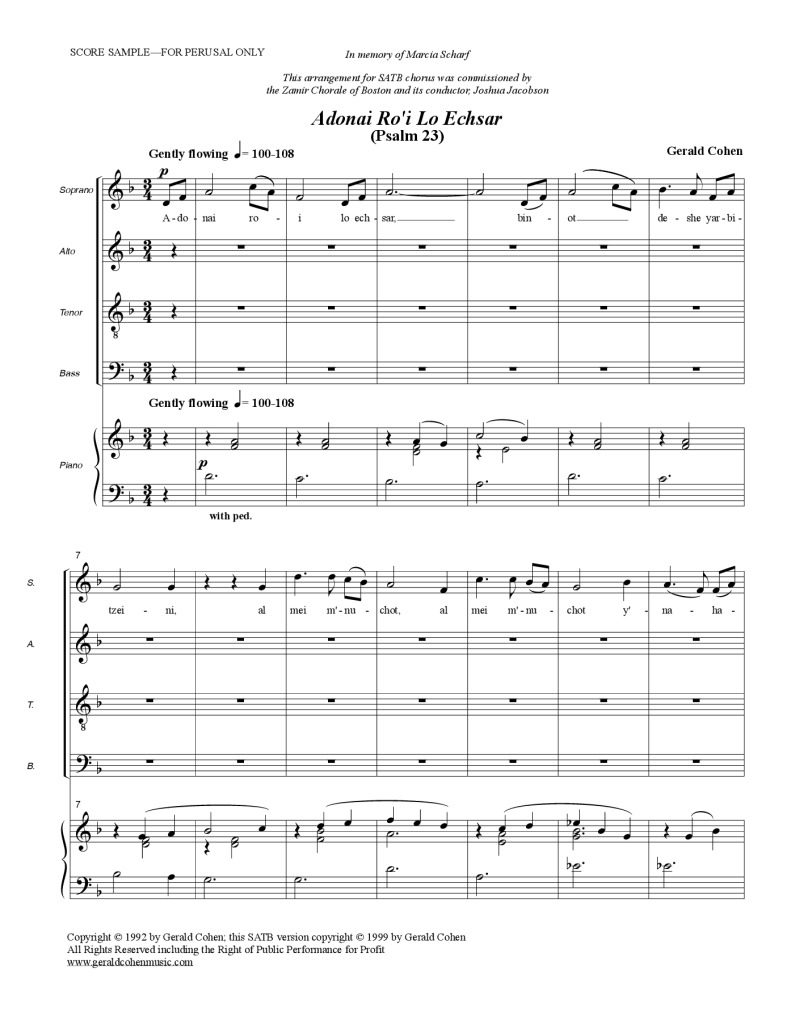
Adonai Ro’i was originally written, on the loss of a dear friend, as a solo a cappella melody. I am a cantor, and a dear friend and congregant died of cancer at the age of 42 in 1989. Her husband asked me to sing at her funeral, and I decided to write a setting of Psalm 23, which is traditionally sung at Jewish funerals and memorial services. This was indeed one of those cases of a piece of music just writing itself, in the course of perhaps 30 minutes, as I was filled with the emotions of my friend’s death.
As I started singing the piece at other services, I received a very strong response to it, and decided to make a piano accompaniment. This was published in 1995, and soon was used by cantors all over the country, as well as in churches and other services and concerts. It is a very curious thing for a composer: I write many pieces of music of all kinds, and it is hard to know exactly why one particular piece captures people’s emotions so strongly, but that is what happened with this particular piece.
I was soon asked by the Zamir Chorale of Boston (Joshua Jacobson, conductor) to write a version for SATB chorus, and that version has also been widely performed. I have also arranged it for solo voice and orchestra, and chorus and orchestra; these versions have been performed by the Pittsburgh Symphony Orchestra and the San Diego Symphony.
I just have to assume that the piece somehow taps into the strong emotions that I felt as I was writing it (I had also lost my father about 8 years before, so I am sure that loss is present as well), and that this then communicates itself to performers, listeners, and mourners. In 2003, I had the sad but powerful experience of singing the piece at my mother’s funeral.
I am grateful that this piece has become a way for so many to express deep and delicate feelings. I hope that, if it is a piece that is meaningful to you, that you will feel free to contact me about your experience with it.
I have arranged Adonai Ro’i for many different vocal and instrumental ensembles; a selection of those are listed here. Please contact me with questions about these or other arrangements:
SOLO VOICE OR UNISON CHORUS
Solo voice or unison chorus with piano
Solo voice or unison chorus with piano and obbligato instrument (Flute, clarinet, violin, viola, cello, etc.)
Solo voice or unison chorus with string quartet
Solo voice or unison chorus with piano trio (vn/vc/pno)
Solo voice or unison chorus with orchestra
Solo voice or unison chorus with string orchestra
SATB, SSA, etc.
SATB chorus with piano
SATB chorus with orchestra or string orchestra
SSA chorus with piano
Two voices, a cappella
INSTRUMENTAL VERSIONS
Solo instrument with piano
Two clarinets and piano
Clarinet, viola and piano
Solo version also available in transposed keys.
For instrumental version without voice, see Sea of Reeds page.
Poet/Lyricist: Hebrew Bible, Psalm 23:
Adonai ro’i, lo echsar,
binot deshe yarbitseini,
al mey m’nuchot y’nahaleini.
Nafshi y’shoveiv,
yancheini v’maglei tsedek,
l’maan sh’mo.
Gam ki eileych b’gei tsalmavet,
lo ira ra ki ata imadi,
shivt’cha umishantecha heima y’nachamuni.
Taaroch l’fanay shulchan neged tsor’ray,
dishanta vashemen roshi,
kosi r’vaya.
Ach tov vachesed yird’funi
kol y’mei chayai,
v’shavti b’veit Adonai l’orech yamim.
Adonai is my shepherd, I shall not want.
God gives me repose in green meadows,
God leads me beside the still waters.
God revives my spirit,
and guides me on the right path,
for that is God’s nature.
Though I walk in the valley of the shadow of death,
I fear no harm, for You are with me,
Your staff and your rod comfort me.
You prepare a banquet for me in the presence of my foes,
You anoint my head with oil;
my cup overflows.
Surely goodness and kindness shall be my portion
all the days of my life,
And I shall dwell in the House of Adonai forever.
Adonai Ro’i has somewhat of a different performance history from many of my compositions, as it is used, probably every day, by cantors all over the world at funerals and memorial services.
A few of its most significant concert performances are listed here:
November 2010: American Conference of Cantors, Lauren Bandman, cond., Basilica Santa Maria degli Angeli e dei Martiri, Rome, Italy
December 2004: Pittsburgh Symphony Orchestra, Daniel Meyer, cond., with the Children’s Festival Chorus, Heinz Hall, Pittsburgh PA
October 2002: Usdan Festival Chorus and Orchestra, Carnegie Hall, New York, NY (premiere of version for SATB with orchestra)
November 2000: Zamir Chorale of Boston, Joshua Jacobson, cond. (premiere of SATB version)
March 2000: Marin Cosman, soprano; San Diego Symphony, Jung-Ho Pak, cond., (premiere of version for solo voice with orchestra)
1997: Featured in the film, The Jew in the Lotus, with Gerald Cohen, baritone
May 1994: Syracuse Children’s Chorus, Barbara Tagg, cond. (premiere of unison chorus version)
by Eric Haines Hebrew liturgy provides blessings for every major event in the Jewish life cycle. Blessings for children, weddings, the Kaddish, the Kol Nidre and the Song of Solomon have inspired composers to write works that deserve a place on the concert stage. The Pittsburgh Jewish Music Festival ended its three-concert season on Tuesday […]
by Sheila Steinman Wallace In one of the most cohesive and moving concerts I have heard from this community chorus, Voces Novae presented “Choral Portraits: Gerald Cohen, Eleanor Daley and Eric Whitacre” on Sunday, March 7. … Gerald Cohen’s “Adonai Ro’i” (Psalm 23) has long been a personal favorite. The chorus and soloist Sarah Nettleton […]
About – Score – Text – Arrangements – Listen/Watch – Performances – Press
$30 full score and parts
“Kumi ori“ was written to be performed, with “Haam Haholchim Bachoshech” and a new arrangement of “Adonai Ro’i Lo Echsar,” as insertions in a performance of Handel’s Messiah, as described below. It can be performed that way, or as a separate choral piece.
Kumi Ori (Arise, Shine) was commissioned in 2021 by the Aspen Choral Society under the direction of Paul Dankers, in loving memory of Patricia “Pat” Smith. The chorus wanted, as part of their annual performance of Handel’s Messiah, to have three of the movements of the Handel composition replaced in performance by newly composed movements; in each case, these new pieces were to be choral movements replacing solo or instrumental movements of the Handel. I was intrigued, honored, and a little bit daunted in taking on this task, but then began studying the Handel and grew fascinated with the idea of writing new pieces that would fit smoothly into the flow of Messiah, and yet be true to my own musical voice. And since I am Jewish and write many compositions in Hebrew, I decided to compose pieces that would use Hebrew texts that are composed in English in the Messiah.
This piece is composed to replace the “Pastoral Symphony” movement of the Handel. The “Pastoral Symphony” comes after the great choral movement “For unto us a child is born,” and my piece is written so as to respond directly to the motifs and energy of “For unto us,” beginning with sixteenth-note figures taken from that movement, but in a new, more distant key, and shifts between different tonalities, and rhythmic meters. When the chorus enters, it is singing a long lyrical line against the continuing energy of the accompaniment, and on the text Kumi Ori (Arise, Shine), from Isaiah Chapter 60, one that was also part of the movement “O thou that tellest good tidings to Zion.” The end of the movement eventually becomes more serene, leading to the following recitative and next part of the narrative in the Handel.
The premiere of this and its companion movements was in December 2021, as part of the Aspen Choral Society’s performance of Handel’s Messiah; the Aspen Choral Society has since performed the pieces each year in their Messiah concerts. While they are written to fit into the context of the Handel, they can of course also be performed separately as independent pieces. With their themes of light emerging from darkness, the new pieces are also suitable for Chanukah performance.
Commissioned by the Aspen Choral Society under the direction of Paul Dankers, in loving memory of Patricia “Pat” Smith.
(Isaiah 60:1)
Kumi ori ki va orech, uchvod Adonai alayich zarach.
Arise, shine, for your light has come, and the glory of the Lord has dawned over you.
Orchestration for Strings, 2 oboes, 2 trumpets
Premiere: Aspen Choral Society, December 2021
Aspen Choral Society, December 2022
Aspen Times, 2021: Aspen choir adds new movements to Handel’s ‘Messiah’
Arrangement of the second movement of String Quartet No.2
Premiere by Riverside Symphony